
Your ears don't come with a warranty. Here's what every concert goer and music fan needs to know about noise induced hearing loss — and how to keep the music alive for decades to come.
The Short Version: Loud Sound Kills Hair Cells. They Don't Grow Back.
Inside your inner ear, thousands of tiny hair cells convert sound vibrations into electrical signals your brain interprets as music. When those cells are exposed to loud sound — especially for extended periods — they bend, break, and eventually die.
Here's the thing that matters: in humans, those hair cells do not regenerate. Once they're gone, they're gone. The hearing loss is permanent.
This is called noise induced hearing loss (NIHL), and it's one of the most common — and most preventable — forms of hearing damage on the planet. According to the CDC, roughly 40 million Americans aged 20 to 69 have some degree of NIHL. Globally, nearly half of people aged 12 to 35 are exposed to unsafe noise levels from personal listening devices and entertainment venues.
How Loud Is Too Loud?
Sound is measured in decibels (dB). The scale is logarithmic, which means small increases represent massive jumps in intensity. A 10 dB increase means a sound is twice as loud as the one below it.
Here's a quick reference:
- 60 dB — Normal conversation
- 70 dB — Safe for extended listening. No risk.
- 85 dB — The danger threshold. Prolonged exposure (8+ hours) can cause hearing damage.
- 100 dB — Hearing damage can begin in as little as 15 minutes
- 110 dB — Safe exposure drops to roughly 2 minutes
- 115 dB — Damage can start in under 1 minute
- 120+ dB — Risk of immediate, permanent hearing loss
Now think about where most music fans spend their time.
How Loud Are Concerts? Louder Than You Think.
The average rock concert hits between 90 and 120 dB. Metal shows regularly exceed 110 to 120 dB, and some legendary performances have gone far beyond that.
A few real examples from music history:
- Manowar holds the record at 139 dB during a sound check
- KISS hit 136 dB during a 2009 show in Ottawa — so loud that residents filed noise complaints and the band was forced to turn it down mid set
- Motörhead reached 130 dB at the Variety Theater in Cleveland in 1984, causing actual structural damage to the ceiling
- AC/DC regularly hit 130 dB in the 1980s, and a 2015 Auckland show could be heard over four miles away
- Deep Purple was certified the loudest band in the world by Guinness after hitting 117 dB at the Rainbow Theatre in London — three audience members were knocked unconscious
These are extreme examples. But even a typical club show or indoor venue can easily hit 95 to 110 dB, especially near the stage or the speaker stacks. That's well above the threshold for hearing damage within minutes.
The Ringing After a Show Isn't Normal. It's Damage.
That ringing, buzzing, or muffled feeling in your ears after a concert? That's called tinnitus, and it's your ears telling you they've been hurt.
For most people, temporary tinnitus fades within hours or a couple of days. But with repeated exposure — show after show, year after year — it can become permanent. A constant ringing or buzzing that never stops. No off switch. No cure.
A landmark 2026 study published in Otolaryngology–Head and Neck Surgery reviewed data from 67 studies across 21 countries involving more than 28,000 musicians. The findings:
- 42.6% of musicians reported tinnitus, compared to just 13.2% of the general population
- 25.7% had hearing loss (vs. 11.6% in non-musicians)
- 37.3% reported hyperacusis — extreme sensitivity to everyday sounds — compared to 15.3% of non-musicians
And here's what surprised researchers: there was no significant difference between classical and pop/rock musicians. The risk crosses every genre. It's about cumulative exposure, not just volume.
Musicians are four times more likely to develop hearing loss and 57% more likely to have tinnitus than the general public. But it's not just musicians at risk. If you attend shows regularly — even a few per year over a couple of decades — the damage adds up.
What About Fans? Concert Goers Are at Risk Too.
You don't have to be on stage to hurt your hearing. Studies have found that over 80% of rock concert attendees showed measurable temporary hearing loss within minutes of the show ending, and the majority still showed reduced hearing nearly an hour later.
The math is simple. A typical metal show runs 2 to 3 hours. The safe exposure time at 100 dB is about 15 minutes. At 110 dB, it's roughly 2 minutes. At 115 dB — common near the front — it's under 60 seconds.
Every show without protection is a withdrawal from a hearing bank account that doesn't accept deposits.
The Early Warning Signs Most People Ignore
Noise induced hearing loss doesn't usually happen overnight. It builds gradually, which is exactly what makes it dangerous. Here's what to watch for:
- Ringing or buzzing after shows that takes longer and longer to fade
- Difficulty hearing high pitched sounds — doorbells, birdsong, certain consonants (S, F, T)
- Trouble following conversations in noisy environments like bars, restaurants, or backstage
- Needing to increase the volume on headphones, TV, or your phone more than you used to
- Muffled or distorted perception of music — losing the detail and clarity you used to hear
By the time most people notice these symptoms, permanent damage has already occurred.
The Fix: Hearing Protection That Doesn't Kill the Music
Here's where most people check out. Because when you hear "earplugs," you think of those foam cylinders that turn your favorite band into a muffled mess. They kill the highs, they muffle the mids, and the whole experience suffers. No wonder nobody wears them.
But that's the old way. Modern high fidelity earplugs work completely differently.
Instead of blocking all sound indiscriminately, high fidelity earplugs use precision filters to reduce volume evenly across all frequencies. The lows stay full. The mids stay present. The highs stay crisp. Everything just gets quieter — the way turning down a perfectly mixed board would sound.
You still hear every riff, every kick drum, every vocal line. You just hear it at a level that won't destroy the cells in your inner ear.
HEAVYS H1F1 High Fidelity Earplugs
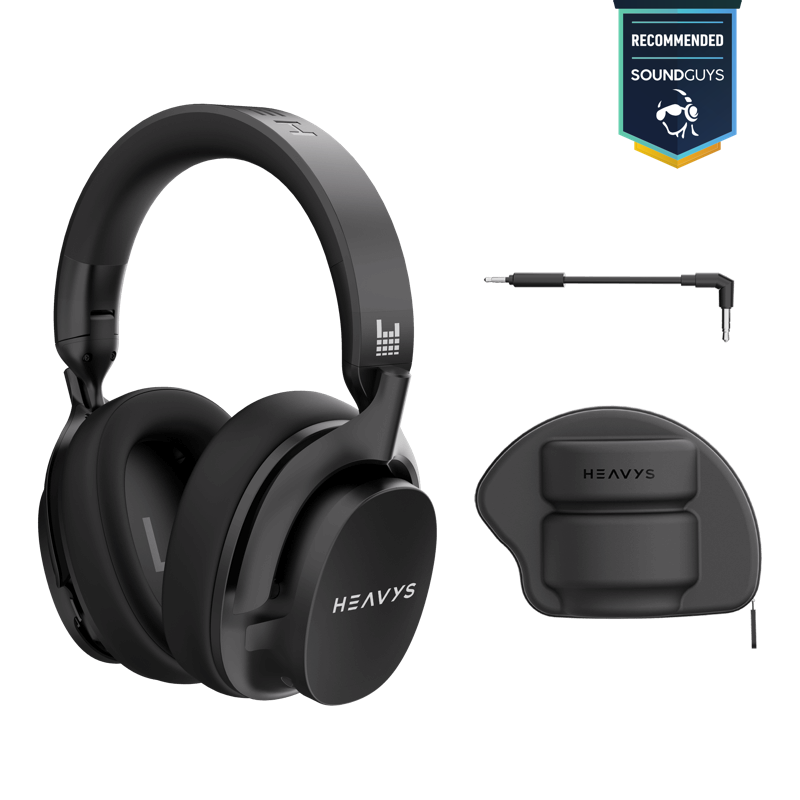
We built HEAVYS for people who live and breathe music. The H1H headphones and H1E earbuds are how you experience it at home, on the go, at the gym. But when you're at the show — standing in front of the stage, feeling the bass in your chest — you need protection that respects the music.
HEAVYS H1F1 Earplugs are high fidelity, reusable earplugs that reduce volume by up to 23 dB (SNR) while keeping music quality and clarity intact.
What that 23 dB reduction means in practice: A 115 dB metal show drops to around 92 dB — well within safe listening range for a full set. A 100 dB club gig drops to a comfortable 77 dB. You get the full experience. Your ears get to live another day.
Specs:
- SNR 23 dB noise reduction (H: 26 dB | M: 19 dB | L: 18 dB)
- Silicone earplugs with polycarbonate filter
- Reusable — not disposable
- Branded keychain carry case included (clip it to your belt loop, bag, or keys)
- Transparent design — low profile, discreet
The difference vs. cheap foam earplugs: Foam earplugs cut anywhere from 15 to 30 dB, but they do it unevenly — slashing high frequencies while barely touching the lows. The result is a muddy, bass heavy blur that doesn't sound like music anymore. High fidelity earplugs like the H1F1 attenuate evenly, preserving the full frequency balance. The show sounds like a show. Just safer.
Who Should Be Wearing Earplugs?
Short answer: anyone who cares about still hearing music in 10, 20, 30 years.
Longer answer:
- Regular concert and festival goers — even 5 to 10 shows a year adds up over a decade
- Musicians and touring crew — occupational hazard, full stop
- Fans who stand near the front or the speakers — the loudest zone at any show
- Anyone who's ever had ringing after a show — that's your warning sign
- Parents bringing kids to their first shows — start the habit early
- People with existing tinnitus or hearing sensitivity — protect what you have left
Pete Townshend of The Who has said his hearing is virtually gone after a lifetime of performing without protection. Eric Clapton, Chris Martin, and Ozzy Osbourne have all spoken publicly about tinnitus and hearing loss. These aren't cautionary tales from a pamphlet. They're the legends of our scene telling us what they wish they'd done differently.
Protect Your Ears. Keep the Music.
We're not here to tell you to turn it down. We're here to tell you to gear up. The same way you'd bring the right headphones for the commute or the right pair for a gaming session, you bring the right earplugs for the show.
HEAVYS H1F1 Earplugs clip right onto your keys or bag. They're always with you. And when those opening chords hit and the crowd surges — you're hearing everything. Every note, every harmonic, every scream. Just without the permanent damage.
You upgraded your headphones. Now upgrade your live experience.
FAQ: Hearing Protection for Concert Goers
How loud is a typical rock or metal concert? Rock concerts average between 90 and 120 dB. Metal shows regularly hit 110 to 120 dB or higher, especially near the stage and speaker stacks.
How quickly can loud music damage your hearing? At 100 dB, hearing damage can start in as little as 15 minutes. At 110 dB, the safe window drops to roughly 2 minutes. At 115 dB, exposure of under 1 minute can begin causing damage.
What is noise induced hearing loss (NIHL)? NIHL occurs when loud sound damages the delicate hair cells in your inner ear. These cells convert sound into signals your brain can process. Once damaged, they don't regenerate — the hearing loss is permanent.
What is tinnitus? Tinnitus is a ringing, buzzing, or hissing sound in your ears that isn't caused by an external source. It's often the first sign of noise induced hearing damage. It can be temporary after a single loud event, but repeated exposure can make it permanent.
Do earplugs ruin the concert experience? Cheap foam earplugs muffle sound unevenly and can make music sound muddy. High fidelity earplugs like HEAVYS H1F1 reduce volume evenly across all frequencies, preserving the full clarity and balance of the music — just at a safer level.
How much noise do HEAVYS H1F1 Earplugs reduce? Up to 23 dB (SNR). That can bring a 115 dB show down to around 92 dB — well within safe listening range for a full concert.
Are HEAVYS H1F1 Earplugs reusable? Yes. They're made from durable silicone with a polycarbonate filter and come with a branded keychain carry case so you always have them on you.
Can hearing loss from loud music be reversed? No. Noise induced hearing loss is permanent. The hair cells in your inner ear do not regenerate once damaged. Prevention is the only strategy.
What are the signs of hearing damage from concerts? Ringing or buzzing after shows, difficulty hearing high pitched sounds, trouble following conversations in noisy settings, needing to increase volume on devices, and muffled or distorted music perception.
How common is hearing loss among musicians? A 2026 study of over 28,000 musicians found that 42.6% reported tinnitus, 25.7% had hearing loss, and 37.3% experienced hyperacusis (sensitivity to everyday sounds). Musicians are four times more likely to develop hearing loss than the general population.
