
When Multi-Driver Technology Makes the Difference
Why It Matters
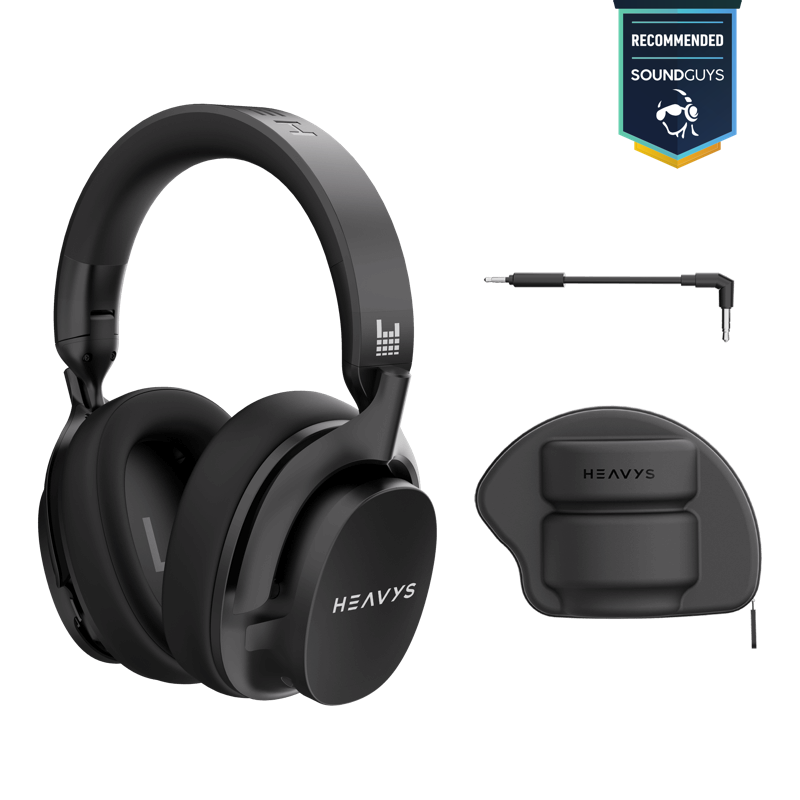
Most headphones use one driver per ear. One speaker trying to handle everything from a kick drum at 40Hz to a high-hat at 16kHz. The result: compression, blur, fatigue. Heavys H1H uses 8 drivers total, 4 per ear, engineered by Axel Grell (the man behind the Sennheiser HD650s). Here's what that actually means in the real world.
Home Listening
The Problem
Familiar albums sound flat. You've heard these songs a thousand times. Nothing surprises you anymore.
With H1H
Dual tweeters handle the high frequencies separately from the woofers. You start hearing the pick scrape before the note, the room in the reverb tail, the second guitar buried in the mix. Music you already know sounds new.
Metal & Hard Rock
The Problem
Dense arrangements, blast beats, layered guitars, growled vocals. Single-driver headphones blur it into a wall of noise.
With H1H
The 8-driver configuration separates instrument groups by frequency range. Bass guitar occupies its own space. Rhythm and lead guitars sit in distinct layers. The kit has depth and placement. You hear the composition, not just the volume.
Gaming
The Problem
Positional audio that should tell you where a threat is coming from sounds vague. You hear it, but you can't locate it fast enough.
With HeX Bundle
8 premium drivers create a wide, accurate soundstage. Footsteps, gunfire, and environmental cues are spatially placed, not just loud. The same multi-driver technology built for instrument separation works for 3D positional audio in-game.
Travel & Commute
The Problem
Ambient noise bleeds into your music. You crank the volume to compensate. By the time you land, you've been listening at damaging levels for hours.
With H1H
HellBlocker™ ANC removes environmental noise before it reaches you. Lower playback volume required. The multi-driver separation still delivers full-range sound at that lower volume. 40-hour battery with ANC on.
Extended Sessions
The Problem
Listening fatigue after an hour. That compressed, fatiguing edge that makes you want to take them off.
With H1H
Axel Grell deliberately tuned the 2.8–4kHz range, the frequency band where human hearing is most sensitive and most easily damaged. Heavys is loud where it should be loud. Precise where precision matters. Less distortion at high volume means you can go longer without fatigue.
The Technical Truth
Multi-Driver Headphones. Every Question Answered.
Multi-driver headphone technology uses more than one speaker driver per ear, with each driver responsible for a specific frequency range. The human hearing range spans roughly 20Hz to 20kHz. A single driver trying to reproduce that entire range simultaneously is forced to make compromises, especially when the audio is complex and loud, like metal.
In the Heavys H1H, each ear contains 4 drivers: 2 woofers handling low and mid frequencies, and 2 high-frequency tweeters. A crossover network divides the incoming audio signal and routes each frequency band to the driver best equipped to reproduce it. The result is cleaner separation, lower distortion, and a more accurate representation of the original recording.
The placement matters too. Axel Grell (the engineer behind the Sennheiser HD650s) positioned the tweeters to mirror how sound reaches the ear naturally in a live environment, from the front, toward the pinnae. This is what creates the spatial "you're at the show" feeling that H1H owners describe.
The Heavys H1H uses 8 drivers total: 4 per ear. Each ear contains 2 low/mid-frequency woofers and 2 high-frequency tweeters. This configuration is protected by a patent and represents Axel Grell's specific approach to reproducing complex, high-energy music with accuracy and minimal distortion.
For context: most consumer headphones, including models from Bose, Sony, and Beats in the same price range, use a single driver per ear. Some audiophile in-ear monitors use 2–4 drivers per ear. 8 drivers total, purpose-tuned for rock and metal frequency demands, is what makes the H1H technically distinct.
Single-driver headphones use one dynamic driver per ear to reproduce the full frequency spectrum. They're cheaper to manufacture and work well for music with limited frequency complexity, but they can struggle with distortion and frequency smearing when audio is dense and loud.
Multi-driver headphones divide the work. Each driver handles the range it's built for. The result is less distortion across the frequency range, better instrument separation in complex mixes, and more accurate reproduction of how a recording actually sounds.
The practical difference: on a single-driver headphone, a blast beat blurs into the guitar riff. On the H1H, the kick drum sits at the bottom, the snare punches through the midrange, the cymbals land in the high end, and the guitars live in their own space. The arrangement becomes audible as separate moving parts, not a wall of sound.
Metal is one of the most frequency-demanding genres in existence. You have extended-range guitars producing sub-bass content, kick drums in the 60–100Hz range, rhythm guitars occupying the 200–2kHz range, lead guitars and solos in the 2–6kHz range, cymbals and high-frequency content up to 16kHz, and all of it simultaneously and at high volume.
Axel Grell put it directly: "Metal has a lot of things going on at the same time. Cheap headphones flatten it." A single driver compresses this information. A multi-driver system with a proper crossover network separates it, giving each frequency band its own physical space.
The result is that metal sounds the way it was recorded: with depth, placement, and detail. You hear rhythm and lead guitars as distinct voices. You hear the bass guitar as a separate instrument from the kick drum. You hear the producer's decisions in the mix. That's what the H1H was built to do.
No. The H1H is Bluetooth-first (BT 5.1) with a built-in amplifier and 50-hour battery. You don't need a headphone amp, a DAC, or any additional equipment. The internal hardware manages the crossover and driver power distribution automatically.
For wired use, the H1H accepts both USB-C and 2.5mm AUX connections, and both are included in the box. For audiophile use cases where you want to bypass Bluetooth and use a dedicated DAC, the wired connection is there. For the other 99% of use cases, Bluetooth handles it cleanly. Supported codecs include SBC, AAC, and aptX Adaptive.
A crossover network is the component that splits an incoming audio signal into separate frequency bands and routes each band to the appropriate driver. In the H1H, low and mid frequencies go to the woofers, high frequencies go to the tweeters. The crossover handles this division continuously and in real time.
The crossover frequency, meaning the point at which the signal is divided between driver types, is a critical engineering decision. Set it wrong and you get a "hole" in the frequency response where drivers don't overlap cleanly, or you get a peak where they overlap too much. Axel Grell's 30 years and 40+ patents in acoustic engineering are largely about solving these problems across a wide range of musical contexts. The H1H crossover is tuned specifically for the frequency demands of rock and heavy metal.
The H1H supports SBC, AAC, and aptX Adaptive. For everyday streaming (Spotify, Apple Music, YouTube Music), AAC delivers solid quality on most phones. For the highest quality wireless experience, aptX Adaptive offers low-latency, high-resolution audio on compatible Android devices.
For the best possible result, use lossless files via wired connection (USB-C or 2.5mm AUX). Streaming services like Apple Music's lossless tier, Tidal HiFi, or locally stored FLAC files pair well with the multi-driver system's ability to resolve fine detail. That said, the H1H's instrument separation and soundstage are audible even on standard Bluetooth streaming. You don't need audiophile-grade source material to hear the difference from a single-driver headphone.
Sony WH-1000XM5 and Bose QuietComfort 45 are excellent general-purpose headphones with strong ANC. Both use a single driver per ear and are tuned for broad appeal, meaning a balanced-to-slightly-warm sound that works across pop, podcasts, and spoken word. They're designed for everyone, which means they're optimized for no one in particular.
The H1H was built specifically for rock and metal. The 8-driver system, Grell's tweeter placement, and the frequency tuning reflect decisions made for the complexity of heavy music specifically, not general consumer preferences. Multiple customers who owned the Sony XM5 directly compared: the most cited observation is that their previous headphones sounded "hollow" afterward. The H1H trades some of the polished smoothness of consumer-tuned headphones for accuracy and detail in complex, high-energy audio.
ANC comparison: HellBlocker™ on the H1H performs at a level that competes with both. Rated by SoundGuys as the top-rated over-ear headphone in its category.
The H1H was engineered by Axel Grell, Heavys' Chief Technology Officer. Grell spent 27 years at Sennheiser as their Chief Sound Engineer, where he designed the HD650, HD800, and other headphones that set the standard for audiophile listening. He holds more than 40 patents in acoustic engineering and transducer technology.
He is not a consultant or a brand ambassador. He is the engineer. Every H1H headphone includes a signed Authenticity Certificate from Grell. His personal reference tracks include Slipknot, Metallica, and diSEMBOWELMENT. His design philosophy: the headphone should reproduce what the artist recorded, not flatten it. Metal demands separation. The H1H delivers it.
The H1H is priced at $259–$299. At that price point, you're comparing it to the Sony XM5 ($349), Bose QC45 ($329), and the entry tier of audiophile over-ear headphones. Every review that mentions the price ends the same way: "worth every penny." That's not a company claim. That's what 4,580 verified purchasers said.
The more honest answer: if you listen to complex, layered music and you've never heard it through a proper multi-driver system, the H1H will change how you listen. That's not a figure of speech. Customers describe hearing details in albums they've owned for years that they never noticed before. If music matters to you, the price is the last thing you'll think about after the first listen.
Payment options include Klarna, Shop Pay, Afterpay, and PayPal, starting from approximately $20/month.